
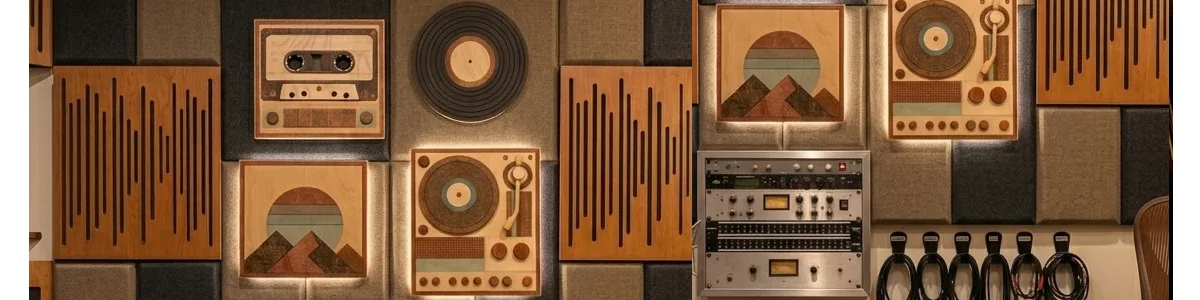
The act of listening to music on analog devices is never just about the sound itself. It starts with a practiced gesture—thumbing the edge of a cassette until it clicks open, or lowering the tonearm onto a spinning record. These moments are tiny ceremonies. The springy resistance of a play button, the dial’s slow arc, the click as tape meets head—each movement is an invitation to presence, to anticipation.
For many, these steps are stitched into the memory of growing up: Saturday afternoons rearranging tapes on a shelf, or evenings measuring a record’s side by the slow migration of the needle. Analog music objects become tokens of a former self. Their wood, plastic, and metal absorb the context in which they were handled—shared songs, private mixes, gifts from a friend, or solitary hours at a desk. Over time, the object’s shape becomes a shorthand for its era and emotions. There is an unspoken link between the ritual of touch and the deep recall of a song or a room long gone.
Most of these machines have vanished from day-to-day life, replaced by the silent swipe of apps. Yet their silhouettes—circular platters, toggle switches, chunky sliders—stay easily legible. The mind recognizes a cassette slot or a tonearm even decades after the last time it was used. Research into design and memory at institutions like the Cooper Hewitt and MoMA has shown that certain forms, once entwined with daily ritual, endure as emotional triggers (Cooper Hewitt; MoMA). It isn’t nostalgia for nostalgia’s sake. It’s the mind’s ability to revisit the feeling of control, of expectation—simply by seeing an object built for engagement.
This is why tactile, kinetic art inspired by these devices creates such a strong home presence. When a handmade wooden cassette player or turntable hangs on the wall, it offers a subtle invitation: reach out, move a dial, press a button. The act is familiar and private, yet visible to anyone in the room. Unlike passive art, these works are designed for ritual—quietly repeatable, a personal performance in the background of daily life.
Cassettes and turntables, while related, each carry their own weight of memory. The cassette is intimate, portable, democratic—recordings made in a bedroom, traded among friends, or rewound for a favorite chorus. Its scale invites personal closeness. In contrast, the turntable is architectural: a stage for albums, an object that signals ceremony and shared listening. It marks space and time in a room, often at the center of gatherings or solitary immersion. Both forms linger in collective memory, but each calls forth different shades of the analog experience.
For those choosing kinetic music art for their space, the decision is often less about which era is best, and more about which ritual feels most honest. Is it the palm-sized mechanics of a cassette, echoing solitary or secretive listening? Or the sprawling gravity of a turntable, conjuring memories of rooms and records shared? The answer is usually already in the hand—muscle memory sparked by a shape, a button, the sound of wood and plastic under the fingertips.